M&D Super Concerned Citizens Special Investigators Series

Screenshot 2015-01-13 18.06.13(2)

This past fall 2014 semester at ESA, students were assigned to become “Super Concerned Citizens Special Investigators (SCCSI)” and make a movie summarizing their findings about e-waste. I am very proud of my students and I thank them for their dedication this semester! I am not uploading the videos because some have used copyrighted sound material… Anyway… Below are their stories:

COLOMB, Gilles + MARION-ARDALAN, Cyrus + TOSTIVINT, Théo
Pros & Cons
15’58
Screenshot 2015-01-13 18.19.10

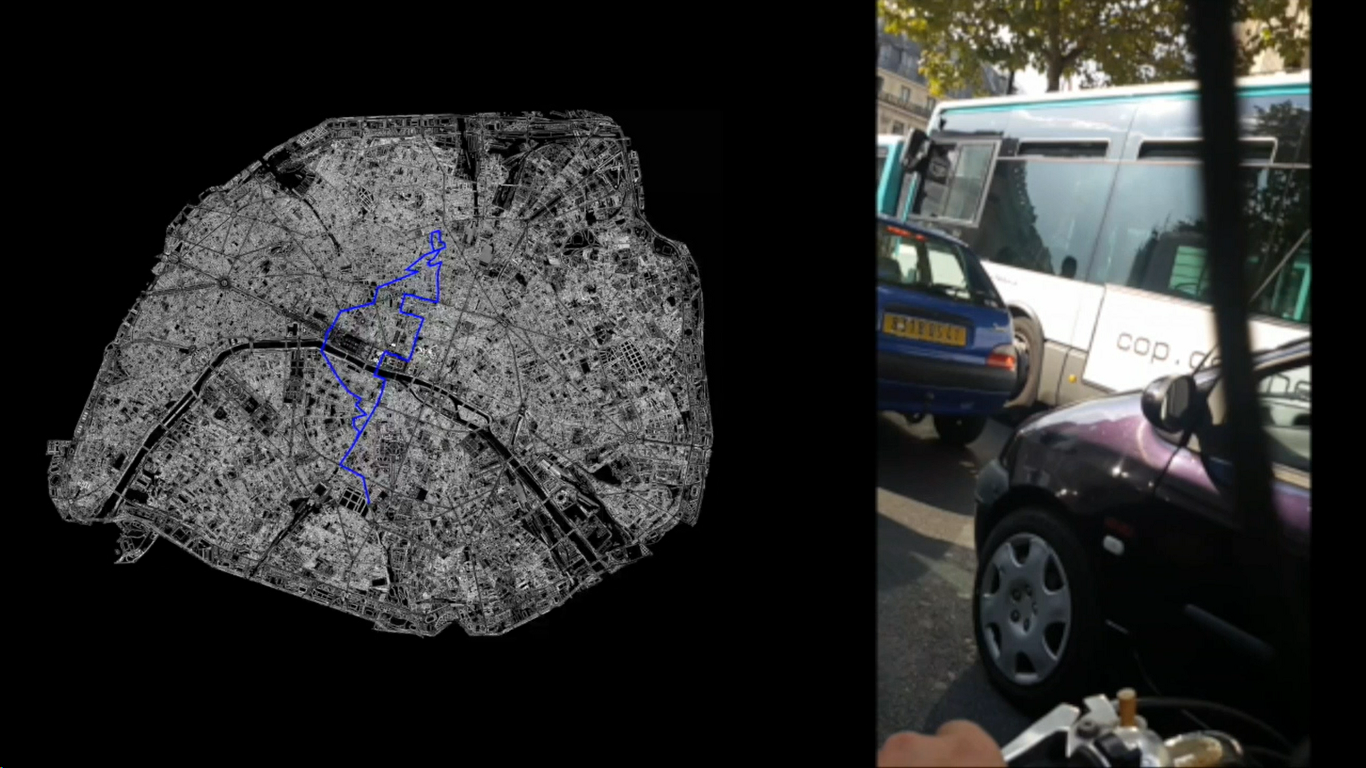
We tried to investigate how to repair a computer that could be considered as reaching its term of life. After looking quickly into the solutions given to us by asking to a certain number of shops (big corporations and small repair shops) we decided to record ourselves into a journey of finding a solution to this problem. The main thoughts that guided us was; is this piece of electronic built to break down and will it be possible to repair it in order to keep it as long as possible? We began our investigation thinking that all the different shops had the same answer to our problem: by replacing our old device by a new one. After dismantling our device and comparing it to newer product we arrived to the conclusion that trying to perfect a product in its weight or thickness, can, with the time, make it more and more difficult to repair especially by making custom made parts or replacing a simple screw by a weld attachment. We can relate this issue to the new ways of designing objects and architectures today; are we building to last or to replace? Is there a programmed obsolescence in architecture? Can we replace a “Gehry” part as well as a “Prouvé” part?

SEBBAN, Julien
More 2 Recycle
5’57
Screenshot 2015-01-13 18.19.33

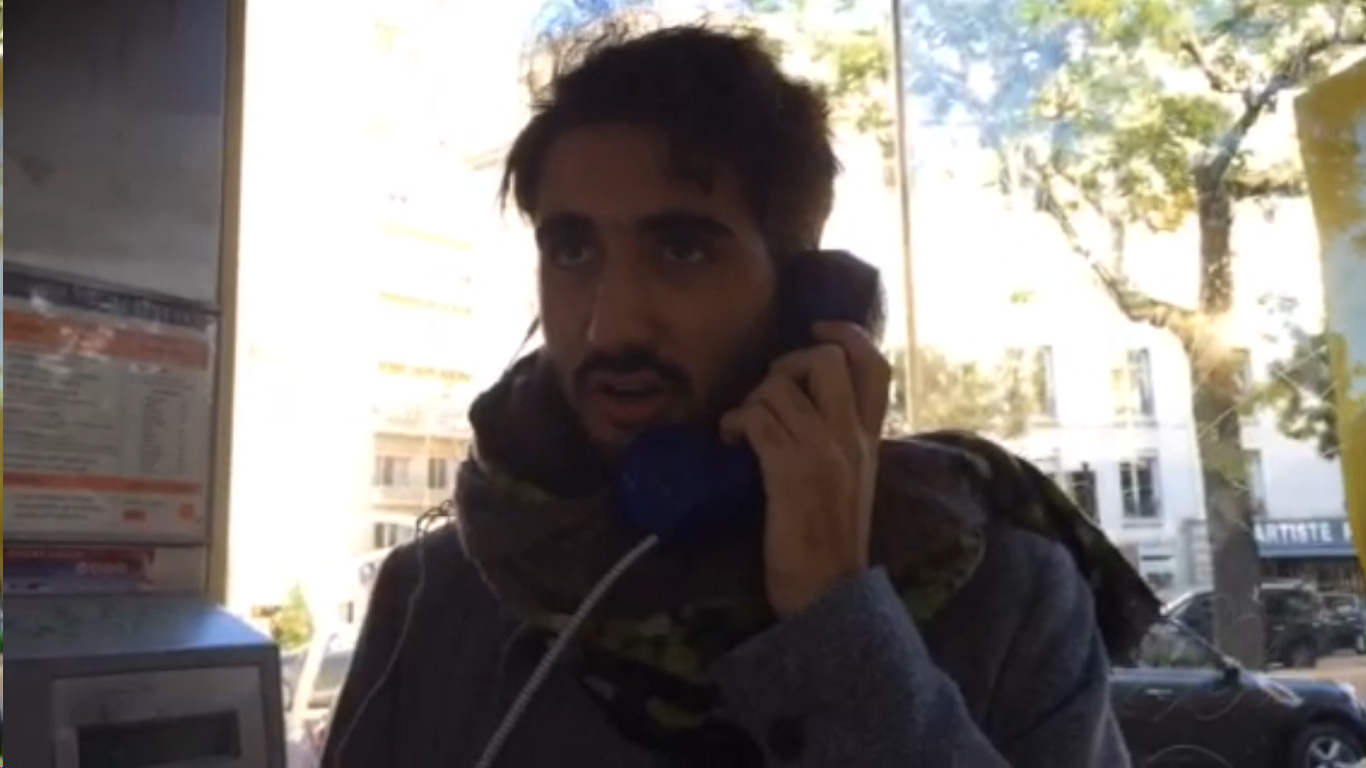
Love2recycle is a website which proposes a solution to collect electronic waste and sell it through the platform. The company buys the old phones for a cheaper price, repairs it and sells it back to other parts of the world. But, how can I make sure that my phone ends up in good hands when I use online recycling platforms? I decided to make my own research and I called the company. By investigating the system, I found a lack of transparency: phones are going sooner to the trash and it increases the quantity of e-waste.
Who is to blame? Who is responsible? Who cares?
The solutions are terrific in the short term. But wouldn’t it be a little more green if companies encouraged consumers to change consumption habits altogether?
The city has evolved… and we are becoming more and more dependent on the machine. Phones have become the extension of our bodies. People are left aside. Design and technology are excluding the person who doesn’t have access to new products. There is a digital divide which creates a huge discrepancy. The society is designed to exclude you when you don’t have a phone.
How can you pay? How can you call?

GHABRA, Hania
Give Way to Giving
7’57
Screenshot 2015-01-13 18.24.14

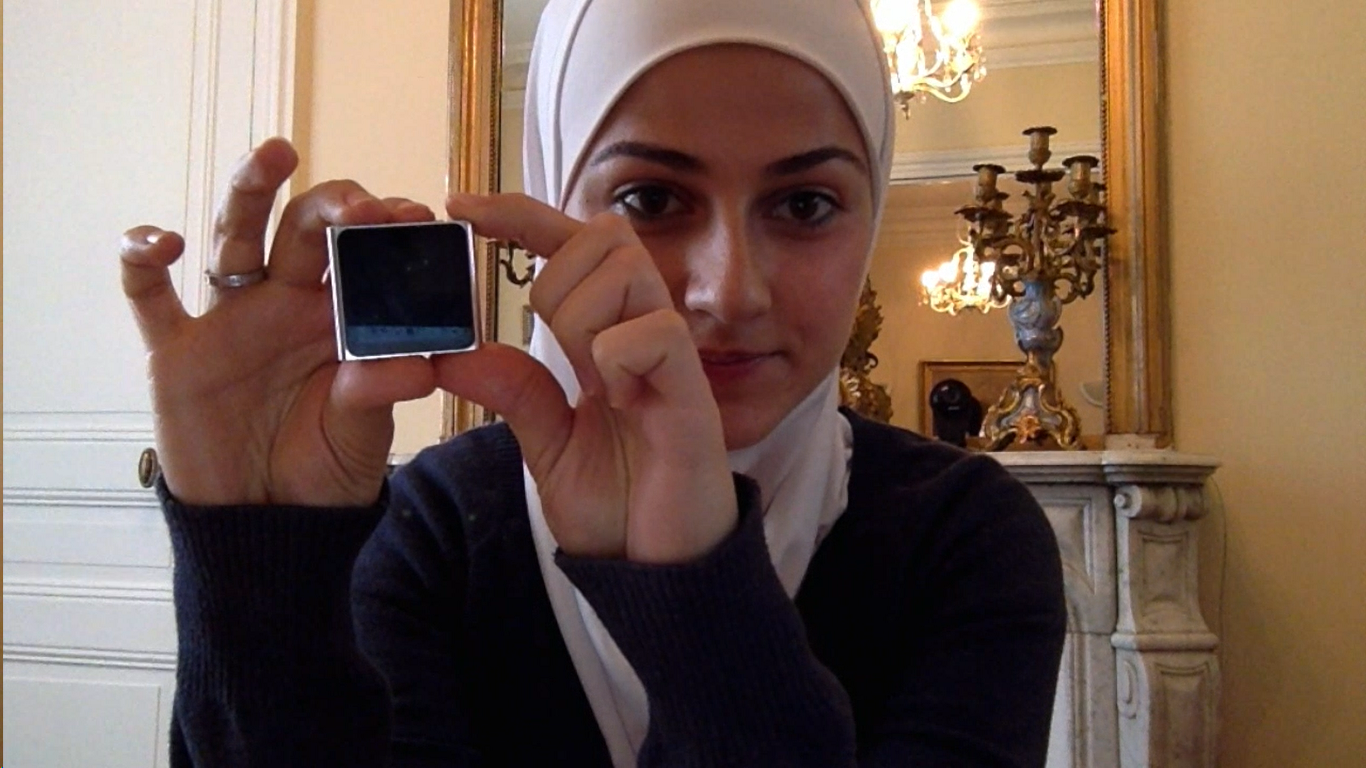
From the moment of purchase of an electronic to the day it is no longer functional, what can we do as responsible consumers to deal with our e-waste. I have looked into my options, and although repairing the object is probably the most popular option to follow, I decided to represent the part of the population with limited technical ability: The non-repairmen and women. Why throw away in the trash when you could give it to someone to make good use of it? The real question is, however, how to find people in need of your e-waste and be sure they are not just another person planning on selling the e-waste for profit? After finding a website that links people willing to give away their object to others willing to take it for their own use, I decided to do a trial and give away my own e-waste. There was instant demand for my iPod, and I was overwhelmed by the number of requests I received. Of course that raised another question: Who are these people requesting my e-waste and which one of them is truly in need of it? With all these unanswered questions, came an interesting twist of events: I realized that my iPod was not broken… it just needed to be charged. Suddenly, I was no longer willing to give away my electronic… This change of heart illustrates the sort of relationship we have with our electronics. We feel possessive of our electronics in their functional state. However, they lose their value once they are broken or out of style. It becomes so easy for us to abandon what we once cherished.

BALAS, Léonard + WOLF-HANSEL, Ginosar
Where Does the E-waste go?
4’23
Screenshot 2015-01-13 18.27.11

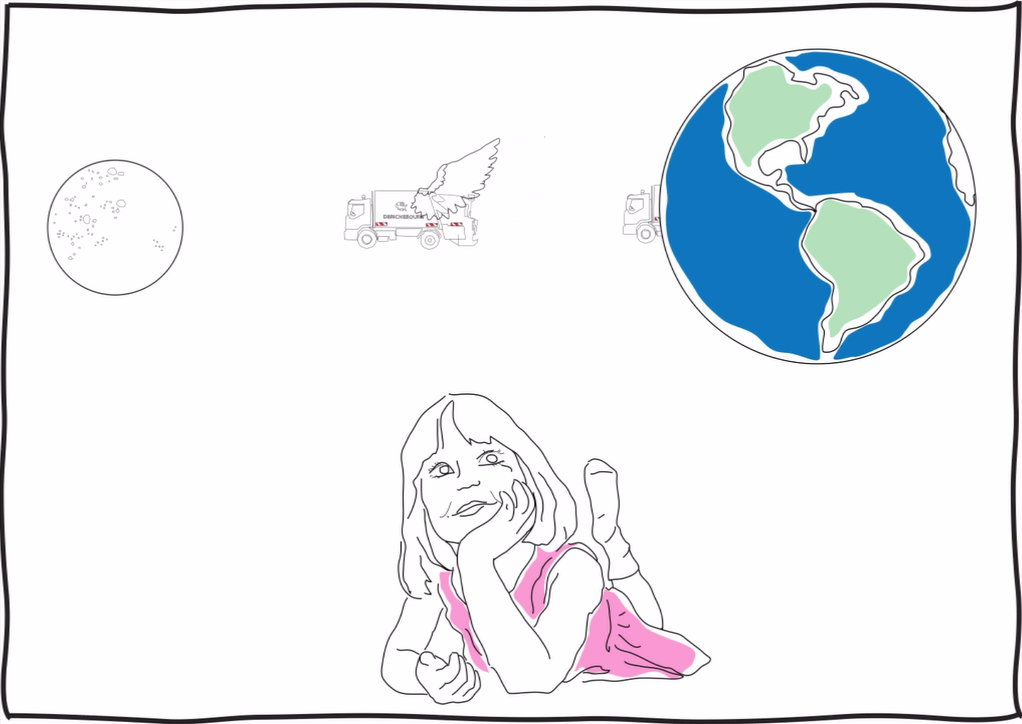
During our short investigation, we tried to answer a question that bothered us as citizens living in a big city: where does all our e-waste go?
When we started to follow our piece of e-waste from the street, we expected to find an answer to this question. But it immediately became clear that it was not going to be easy. After the many bureaucratic obstacles we encountered, we decided to examine whether and what other citizens of Paris think about the daily waste they throw to the street.
Almost everyone answered the same way. The place where the e-waste travels to is UNKNOWN. Surprisingly, even people who worked for the municipal system did not know about the destination of the waste after they leave it in the street. The most surprising fact we discovered was that nobody seems to care about it…
Life in modern cities enables us to ignore some of its constituent systems, if we prefer not to do so. Impressive facades hide poor neighborhoods, underground systems maintain sewage. Thus, life seems to be easier, compared to the past. Nevertheless, it should not be an excuse for responsibility diffusion. We created this animated movie in order to raise the awareness of people to their property, their e-waste.
By a simple web search it is possible to learn about the terrible pollution in African countries caused by toxic e-waste. The information is very accessible but only few people are interested in that and look for it.
How can we, as responsible citizens, take responsibility and change this undesired situation?
There are many answers to this question. what we want to focus on in the future is how to use design as a tool in order to raise awareness and transparency about the life circle of the product we are using, and not only to know where it goes after its broken, but also how it is working.
As architects and designers, how can we integrate in our design the transparency, and design a product who could tell a story?
When the first computers were invented, people saw them as magic boxes. Today, it seem like it never changes. Our whole life going around our smartphones, televisions and other electronic/electric products, but because everything is hidden behind plastic and glass, we can never understand how this product really works, and people don’t really care about what is inside their machines. Maybe we lost something on the way… maybe it’s the curiosity, or the desire of knowledge. If the product works we use it, if it breaks… we buy a new one.
If we would understand more how our electric product is working, maybe we would care more where they go after they break. Making it invisible to understand and easy to fix can decrease the amount of e-waste in the streets and in poor countries.

HIGA, Akemi
A Laptop Journey in Lima, Peru
6’32
Screenshot 2015-01-13 18.28.49(2)

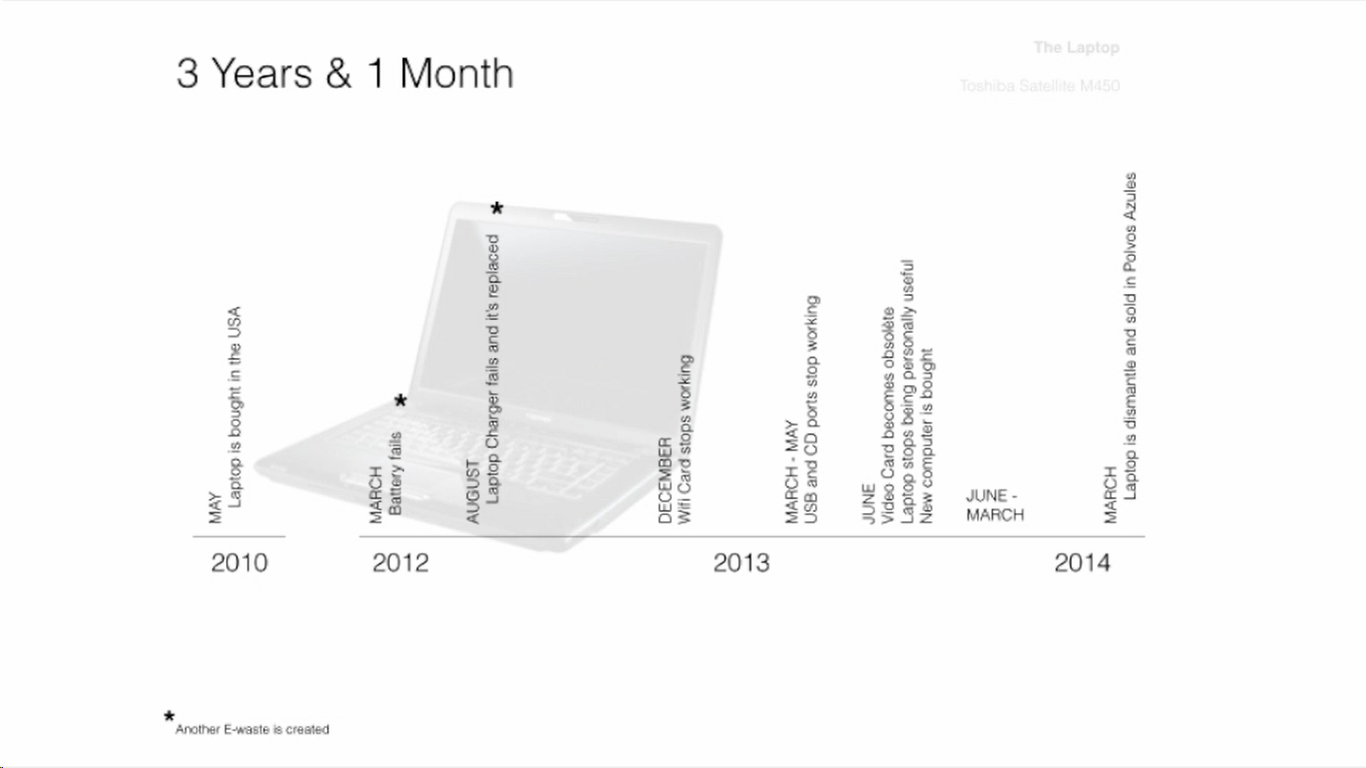
This movie shows the process of recycling an e-waste, in this case a laptop, in the city of Lima-Peru. Because the process took place earlier this year, the story is shown as a kind of chronicle of what happened and the things I learned about the infrastructure and system for recycling available now in Lima. This story takes you with me throughout what I learned in that moment and what I am learning right now about the limits and opportunities for e-waste inside the informal and formal systems simultaneously managed in my everyday live. Starting from getting the laptop, the life spam that it got, the process of recycling it, and the realization that not everything is as simple as one first imagined. The process doesn’t always end where we want it to; and it is up to us to finds alternative ways to deal with the challenges. That is what makes us Super Concerned Citizens Special Investigators.
Architecture here plays the role in two ways: in the overall design of better infrastructure for not only separating and classifying but for actual recycling of technological goods; and as a designer in the questioning of how much of a laptop can be turned into other goods. How can we recycle something that is not designed to be recycled? And even if it is meant to be recycled, how can we accomplished that if the infrastructure doesn’t exist? Who is to blame? The starting point of the process or the last?

KIM, Joongi + KIM, Yongyeob + KWON, Seulkee
Finding the Way to Recycle E-Waste
7’54
Screenshot 2015-01-13 18.30.15

How can we decrease e-waste?
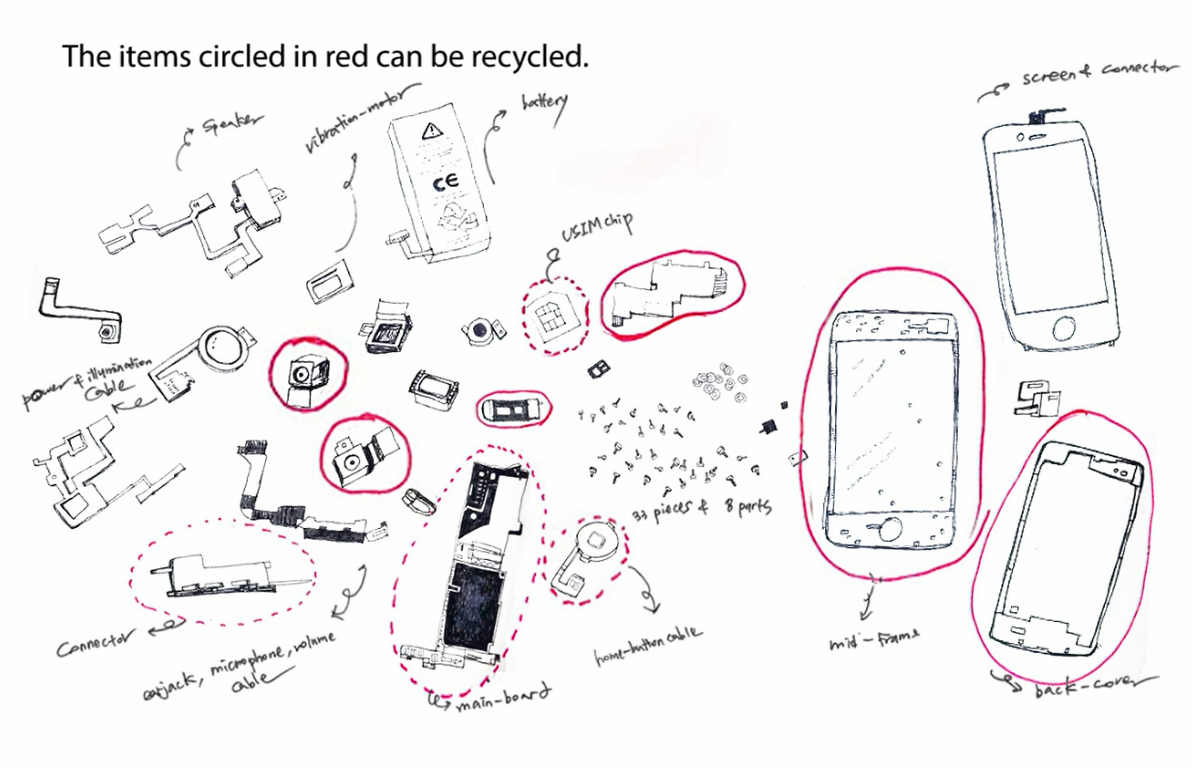
When a smart phone part breaks, we usually buy a new phone… and this even if only one component breaks.
Could we make a new product using the working parts of a smart phone? Can this practice of making new items out of working parts of a broken phone decrease the production of e-waste?
We asked an expert about making items out of parts of phone parts.

ABREO, Daniel
Design for (Dis)assembly
4’02
Screenshot 2015-01-13 18.33.46

Buy it, use it, break it, fix it, trash it, change it, mail – upgrade it,
Plug it, play it, burn it, rip it,
Cross it, crack it, switch – update it…
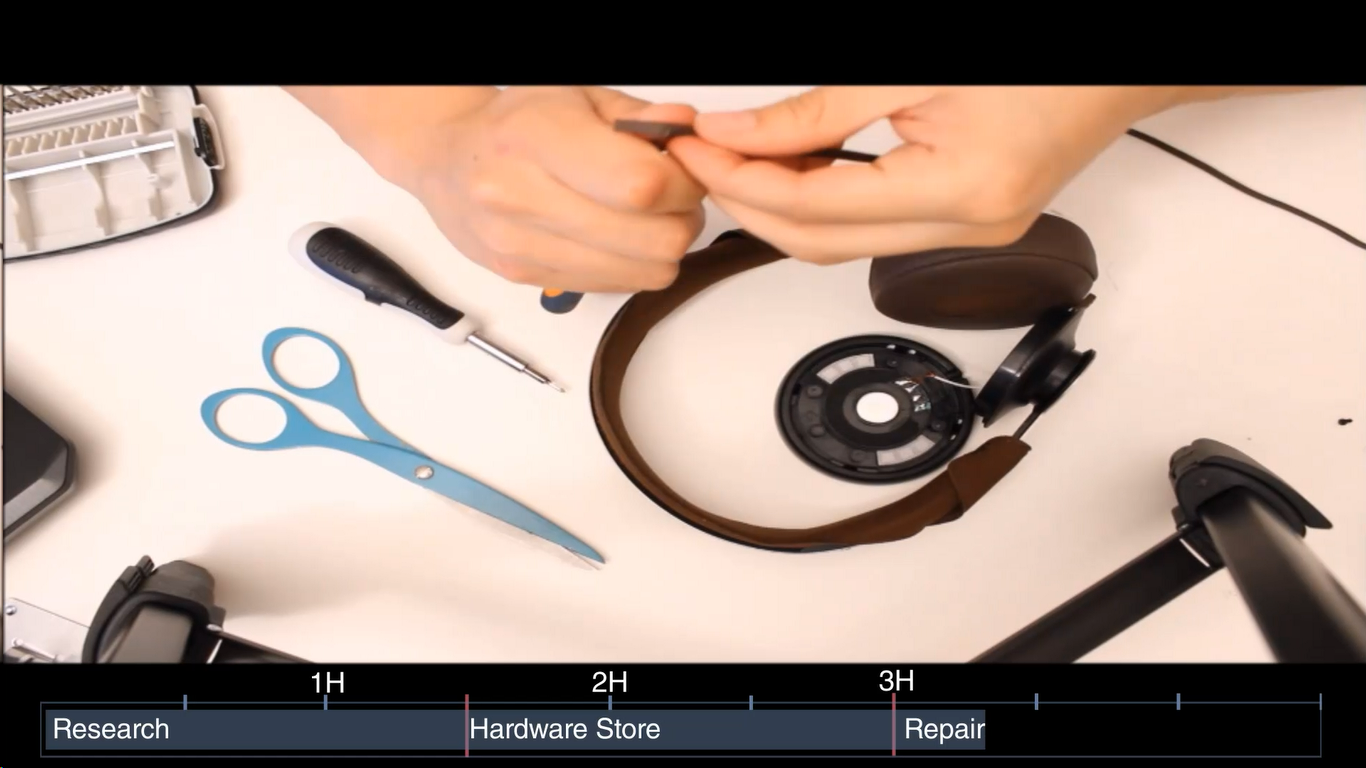
In the past few years headphones market have known a fantastic growth with the multiplication of portable players like mp3 players, iPhones, tablets among others. They have since then become a fashion accessory and as a result many brands release new models every season leading people to consumerism and to change their headphones every other month. In many cases they extremely fragile and have a very short lifespan; yet, the truth is that most of the broken headphones work perfectly and you just need to solder the wires together again. But instead the entire product is just thrown away. Is it an intended weakness?
In this video I tried to show how the (Dis) Assembly process of an object can dictate the evolution of this waste chain. I also try to raise awareness of the consequence or our acts and current education. Most of the waste produced in the world is produced by the construction industry. Architects and designers should acquire a basic notion of the way their products work. They should learn not to systematically rely on others. They should enrich their culture and reaffirm their knowledge in their field. Architects and designers should learn to properly analyze a situation to better re-use or repair instead of always starting from scratch.

VILLALBA, Joaquin
iFix my iPhone
6’32
Screenshot 2015-01-13 18.35.13

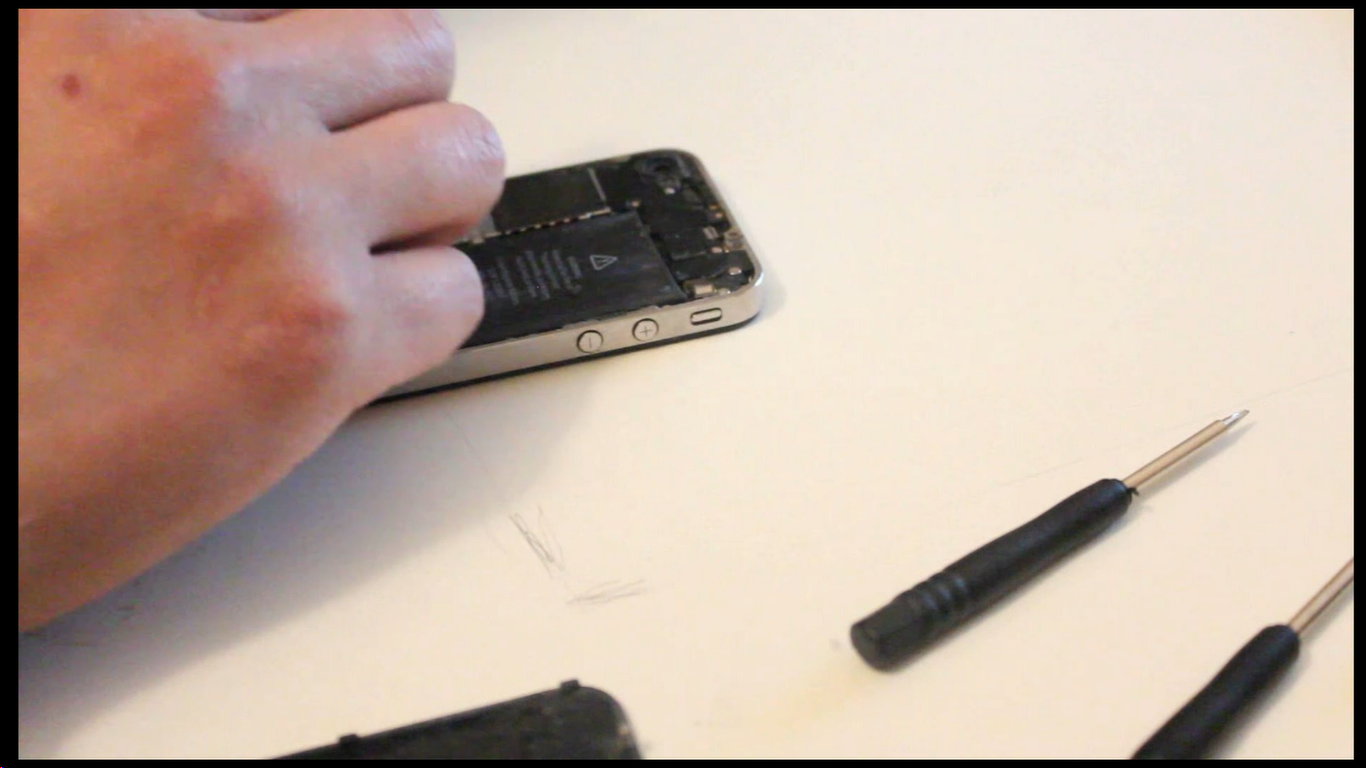
As part of a research on e-waste, I decided to investigate what are the possibilities existing with a broken device, in my case, an old iPhone that wasn’t being use because it was damaged. Time is an inevitable degrading factor that must be managed in order to guarantee the longest lifetime of objects. Getting rid of old devices is not a solution, because that it is moving the e-waste from one place to another, and because this devices are actually still useful; therefore my final goal was to keep the phone in a usable condition. The idea is that everything is going to get damaged and old with time, and the solution is not to be afraid and get rid of the products or get new ones, but to foresee and maintain. Time is the agent that can make an antique of an old car, but it can also cause structure to rust. The solution is to reach for the tools we need, and that are not given to us, to apprehend the influence of time. We are powerful among creations and not the other way.
Made in Agbogbloshie

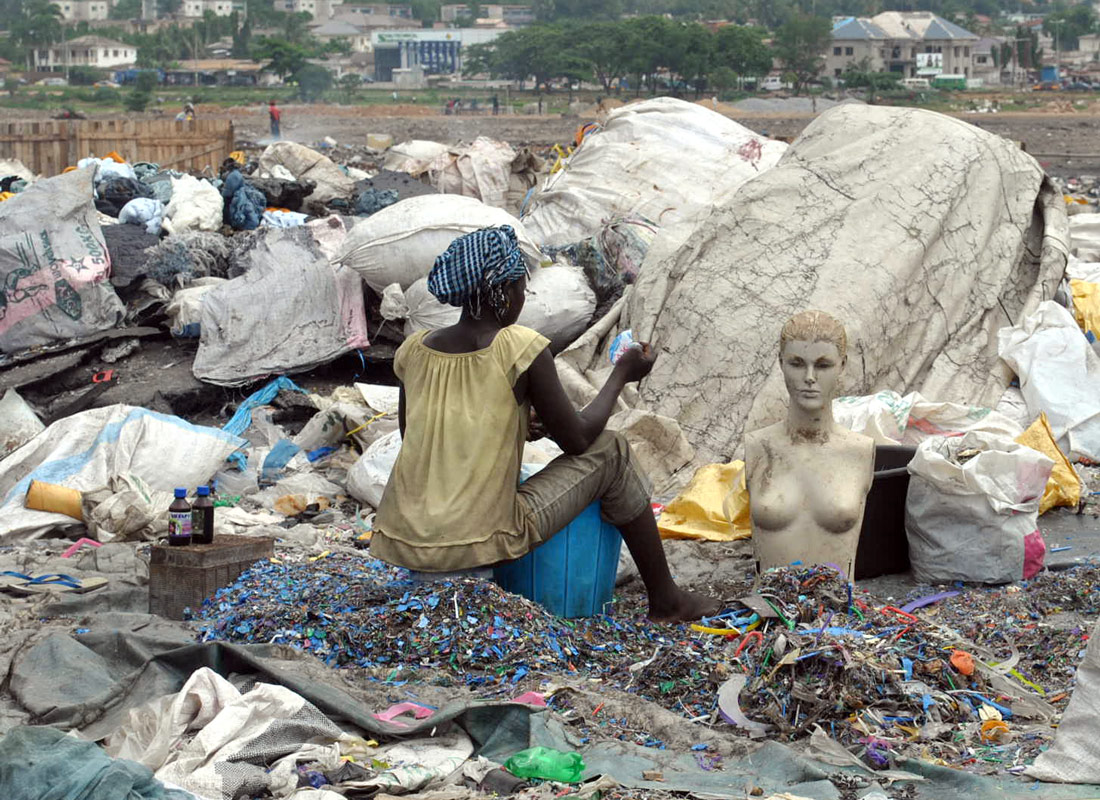
Agbogbloshie is a challenging site. As a space, Agbogbloshie is sensory overload: soil and water darkened from pollution exude noxious vapours under the heat of the sun; toxic fumes emanate from burning sites; the clamour of slamming hammers and banging chisels fills the air… But that is only part of the Agbogbloshie story.

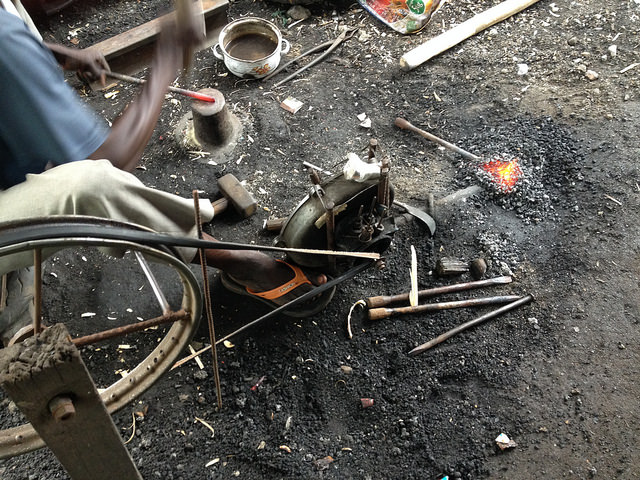
A closer look at the ecosystem of the giant self-organized open-air factory shows that Agbogbloshie is about more than destruction alone. A parallel set of activities support the livelihood of onsite workers: food and entertainment spaces — Agbogbloshie has both a cinema and foosball tables! Numerous mosques dot the landscape (we found a total of 14 mosques in the area surveyed) serving five times a day the faithful that are working nearby. Since believers must take ablution before praying, water circulates in plastic tea pots from water tanks, the few municipal water supplies and public toilets/showers that are sprinkled around the site. Workers also engage in making: making tools (such as chisels) to disassemble e-waste or other items into scrap that has a resalable value, making machines (such as a furnace blowing system using a bicycle wheel) to make these tools, and making items (aluminum pots and coal pots using metals harvested from refrigerators) to sell outside the boundaries of the site.

Agbo-maker-chisel
Furnace blower at a blacksmith workshop making chisels for e-waste disassembly

We love the hand-crafted bicycle tyre-powered blowers used to ventilate locally-fabricated furnaces for cottage industry smelters (seen in various places). They are a powerful example of the on-going knowledge transfer within Agbogbloshie and testament to the intertwined nature of making and technology development. Exactly what AMP seeks to further leverage in Agbogbloshie.

Here is the link to our Flickr album Made in Agbogbloshie. While (e-)waste processing is crude and hasty to maximize profit (informal e-waste workers earn a higher than average income compared to informal workers overall), we certainly see all the parts necessary to make the machine, the self-organized open-air factory, run smoothly. Making is just part of it.

A Spacesuit for the Spacecraft

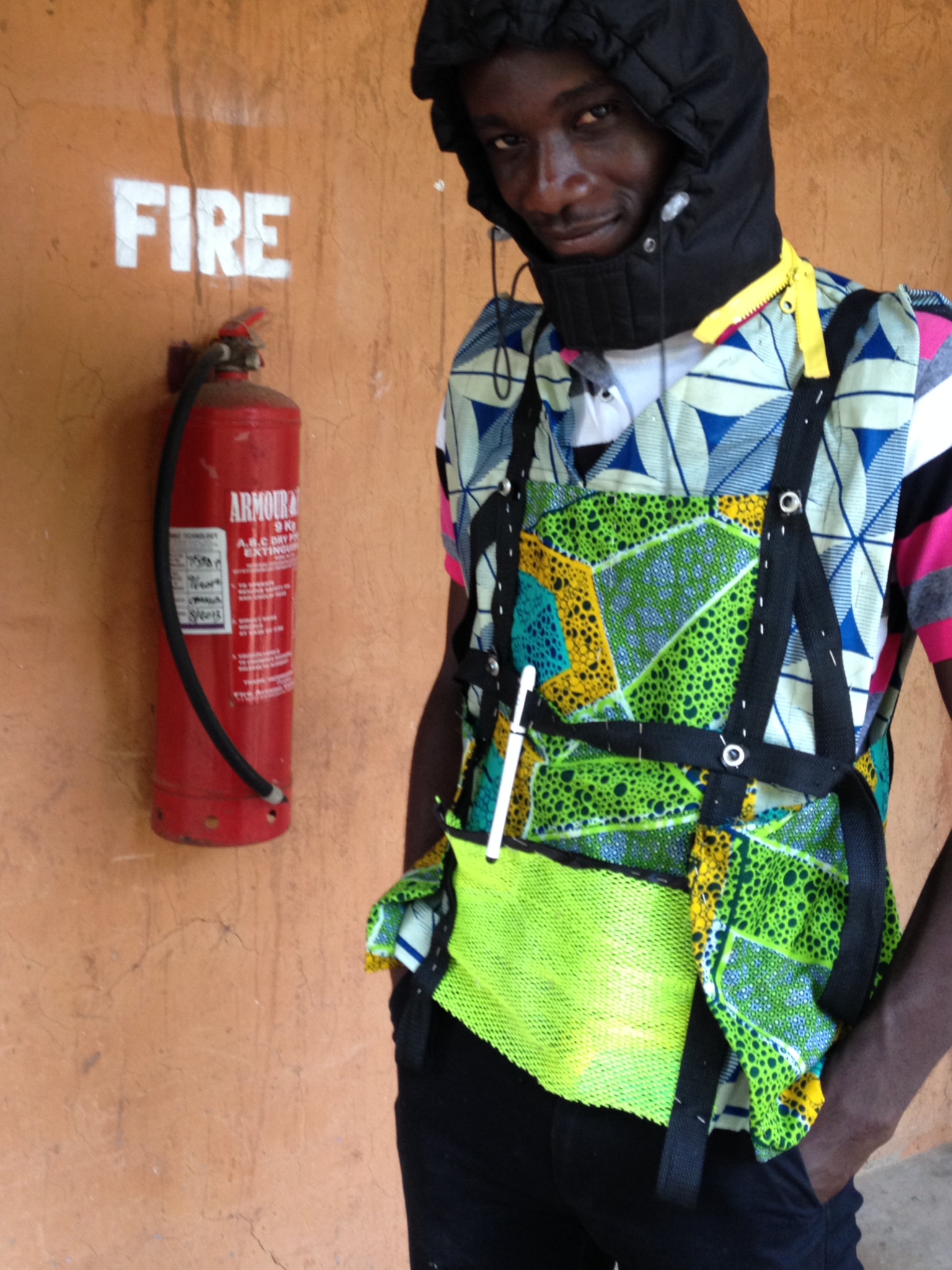
All members of the Woelab (Togo first makerspace) who came to visit us in Kokrobitey were proudly wearing their African print Woelab shirt… It’s because “we are a community!” they proudly said. This is when I realized that the spacesuit that we were designing was more than a utility shirt to carry things around, gas mask, electronic add-ons (such as the speakers that Daniel from the KNUST Creativity Group salvaged from a dead laptop) or tools to disassemble e-waste. Seeing the youth happily wearing early prototypes (version designed by Dk Osseo-Asare for his Low Design Office crew of builders) confirmed the fact that the spacesuit was a tool to bring together people of the AMP maker community.

Spacesuit 1 Emmanuel wearing the first prototype

Kuukuwa and I tweaked the original design, thinking about how to optimize its production process and improve usability. For example we used 1 inch straps in lieu of the hand-made ribbons structure running across. This allowed for the sewing to be faster and more precise. We opened the sides of the utility shirt to ease movement—it now unfolds “like an apron” and eventually could be hanged in the spacecraft and used as soft storage. We also reallocated some of the pockets and minimized cuts in the pattern. Inspired by the way kimonos are cut, we used a folded rectangular piece of fabric to create a back pocket that would nicely fold around the side and close the utility shirt, hence minimizing the number of cuts. We added to a hood to the original design, prospecting for a way to integrate a gas mask eventually developed by the AMP Poly-Science team—the Poly-Science team who also experimented with weather proofing fabric using plastic, which can become handy for the utility wear.

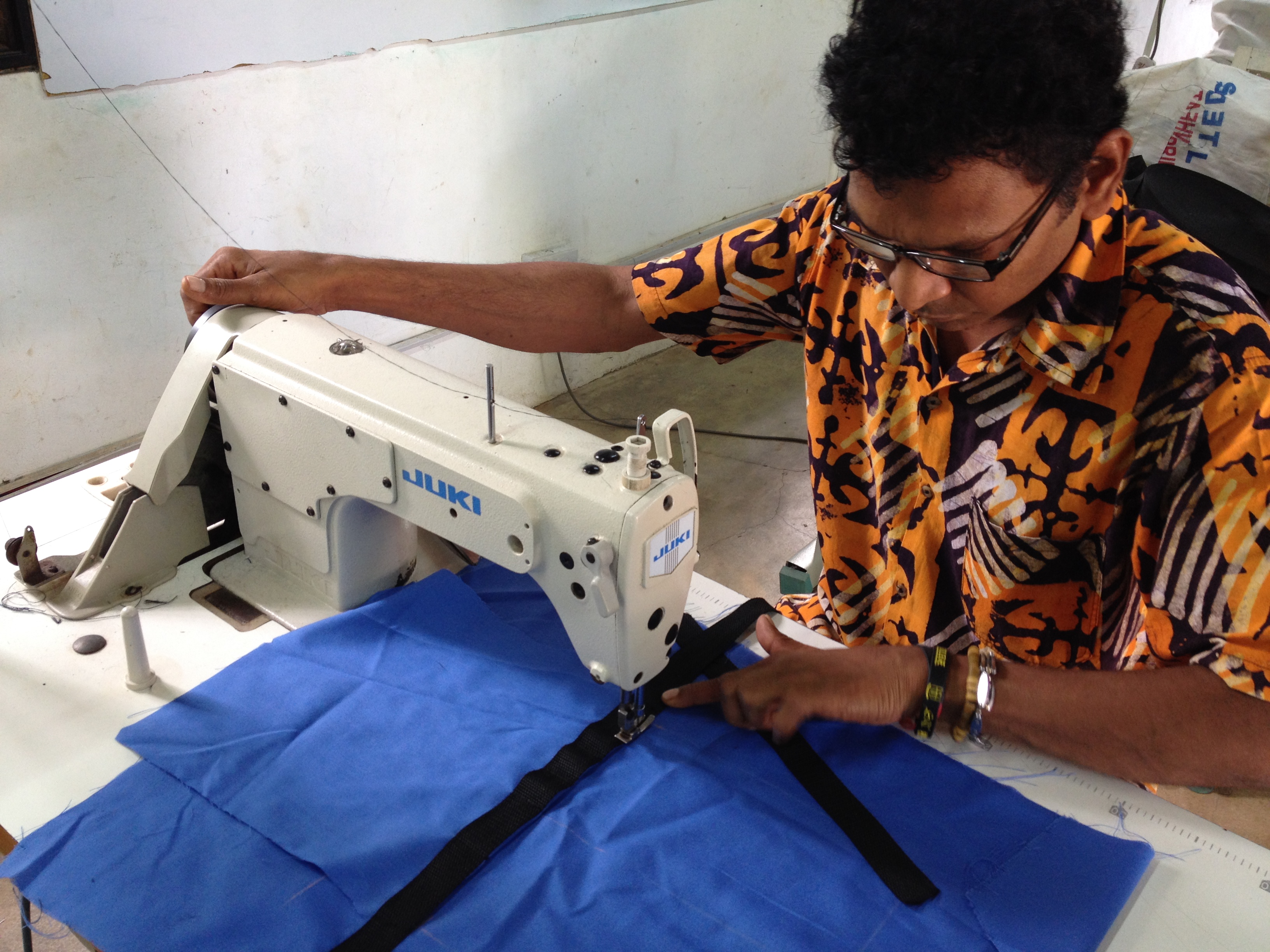
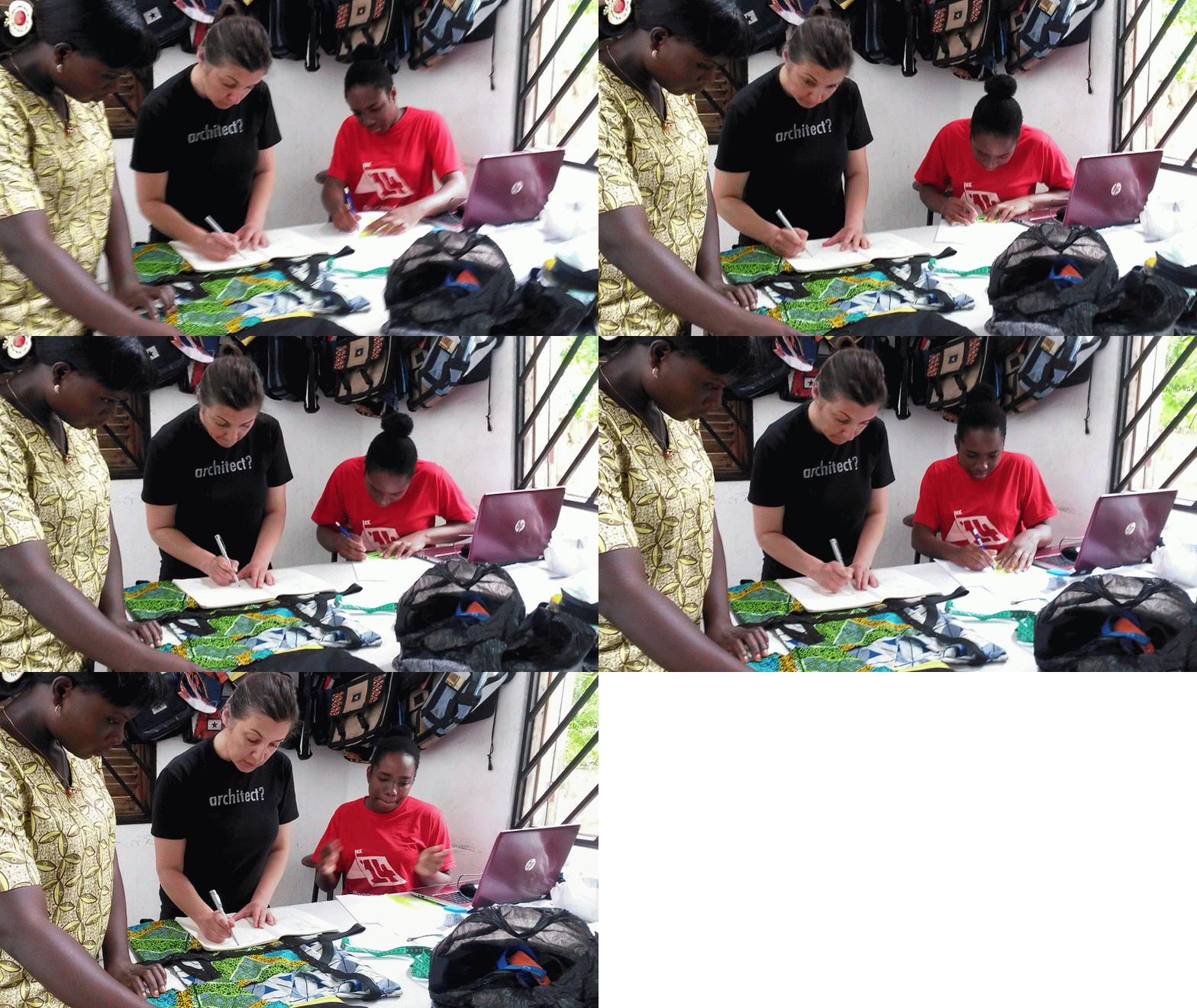
With Emmanuel (AMP maker and model =) and Martine (Woelab), we produced a first prototype using African fabric. While I was getting my head around designing the hood, Kuukuwa drew the overall pattern to pass on to Master Chamil who is the production manager of the Kokrobitey Institute. Million thanks to him and his magic abilities, the second prototype he produced helped further develop the design. A third (final?) prototype is now in the making. We found that collaborating with skilled and open-minded people as Chamil, master maker at heart, was extremely important to advance our own skills as “fashion designer apprentice”. Making is about trans-disciplinary and peer-to-peer learning. It particularly expands your ability as a designer.

Spacesuit 2 Chamil working on the second prototype

There is much more to do for the space suit—a number of electronic add-ons made of e-waste, speakers, solar charging station for mobile phones and finally detailing the cost of the suit, yards of fabric (could this eventually be recycled advertizing material?) needed to finally go into production of a number of them.

spacesuit Martine, Yasmine and Kuukuwa working on the Spacesuit

The Sound of Plastic

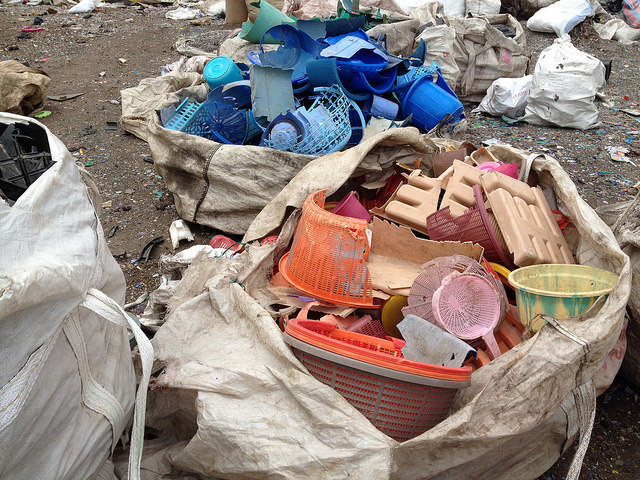
There is more than e-waste processing happening in the open-air recycling factory: plastic processing represents a significant portion of Agbogbloshie’s ecosystem and economy.

Woman in the plastics business

The plastic processing chain involves various actors (male and female — contrary to e-waste processing which does not employ female workers) and machines:

  • Collectors get plastic waste from all around the city and temporarily store them onsite. Dismantlers scrap plastic out of e-waste or other items.
  • Men and women sort out plastics based on empirical and heuristic approaches: they separate plastics according to their thickness, malleability (thermoplastics are malleable and can be recycled, while thermoset plastics are not), and by the sound plastics make when workers bang on them with a screwdriver!
  • In our interaction, workers in Agbogbloshie did not know about the resin identification code system. However, as observed many locally-made plastics lacked labels, as well as scrap pieces of plastic detached from primary parts in which the label is inset. Thus, if the processing is carried out in a hasty and crude manner, then having resin identification codes may not be overly helpful.

As we learned by watching the documentary film The Electronic Tragedy by Dannoritzer Cosima, in other parts of the globe where informal plastic processing also occurs, heuristic approaches include burning plastics with a lighter and smelling the burnt material – each type of plastic has a different burning temperature. This strategy is more dangerous for the workers’ health than local methods of differentiating between types based on the sound of plastic.

Plastics sorted by color
  • In Agbogbloshie, it is common knowledge that television cases (made of non-recyclable thermoset plastics) cannot be sold for recycling. And this is also the reason why the item is often used for storage or as a stool. The local workers separate plastics into three main categories (while there are seven identified categories of plastics. PET (bottles) and PVC (pipes) are in addition): “rubber” (e.g. polypropylene, PP), “gallon” (e.g. high density polyethylene, HDPE), and “plastic” (not recyclable). In all, they process Polypropylene PP, High Density Polyethylene HDPE, Low Density Polyethylene LDPE, Polyethylene Theraphalate PET, Polyvinyl Chloride (PVC), and other types such as PP-MD20, and PP-TD30.
  • Women remove labels and caps of PET containers (water bottles for example; water bottle c­­­aps are made of another type of plastic). Workers sort recyclable plastics by colors before (loud) shredding using locally fabricated shredding machines. They then sieve the shredded plastics before washing it. The plastic is now ready to be sold to industries – local and global!

Prices vary according to the type of plastic and depends on the market. For our plastic experiments, we purchased the Kg of shredded PET for 3 Cedis and the Kg of PP for 2 Cedis. The workers specialized in plastic processing were rather excited about the business opportunity afforded by our plastic experiments (bricks and tiles made with PP and PET) and we look forward to this knowledge transfer.

Find more pictures on Flickr.

M&D Final Review

The M&D final review took place at l’ESA on Friday June 13! Edouard Cabay, teaching the RE- studio at l’ESA, was our special guest on the jury. Teams of students presented four projects: a hydroponic micro-farm, a water distillery, a gas mask and a project to map Agbogbloshie using AMP flickr data.

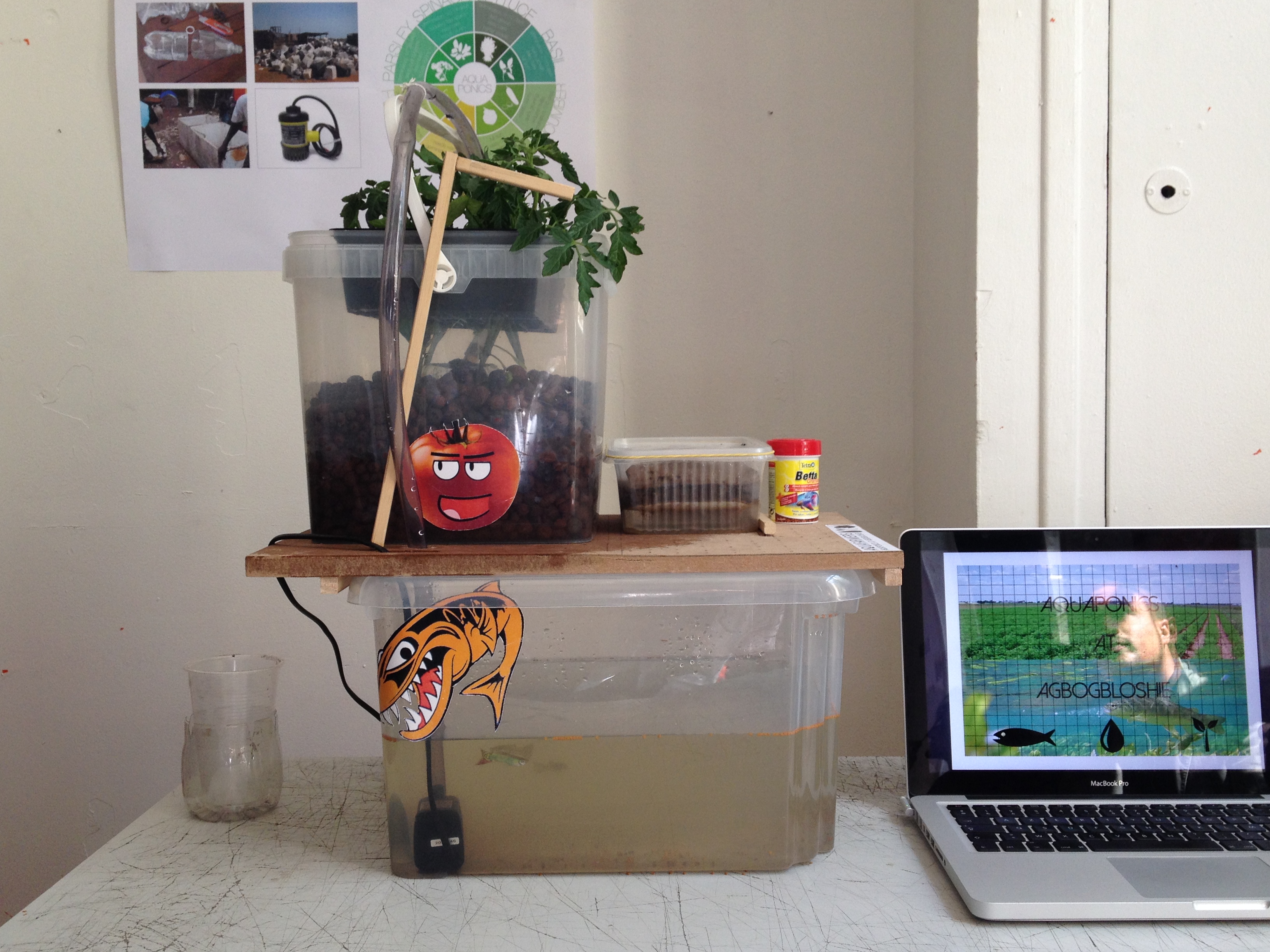
The micro-farm to grow tomatoes and the water distillery used fridge remains (e-waste parts to be found on the dumpsite). Both teams considered as much as possible the context, hence the scale of the projects, DOWN-SCALED to AMP UP! These micro-architecture or “urban robots” as we, AMP founders, like to call them (Also in homage to Japanese architect Toyo Ito, whose first architectural firm was called as such), are seeds for change because they allow for appropriation and replication (anyone in Agbogbloshie should be able to).

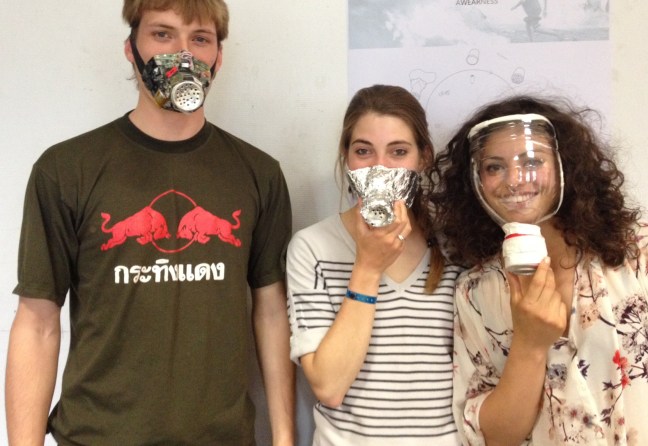
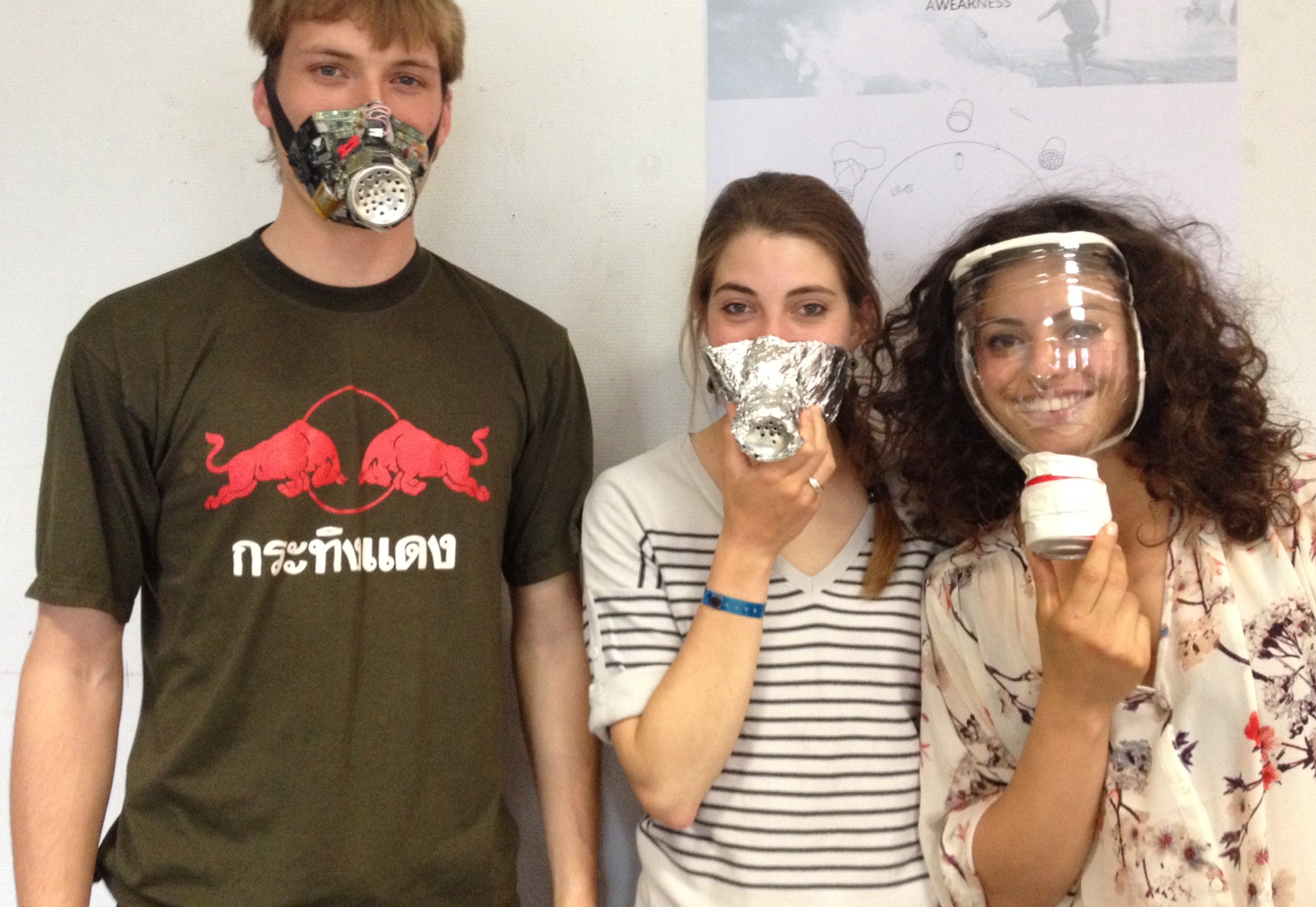
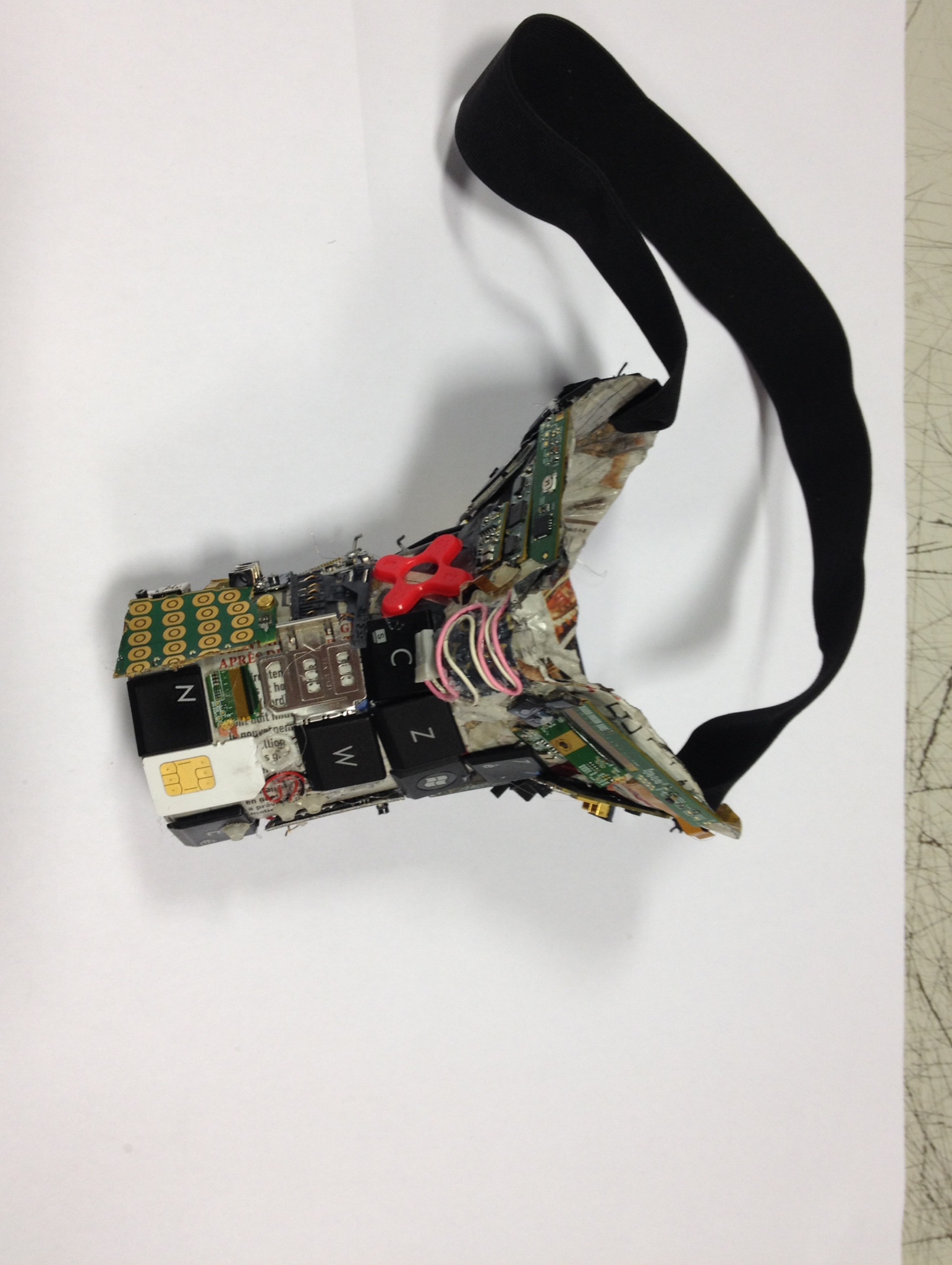
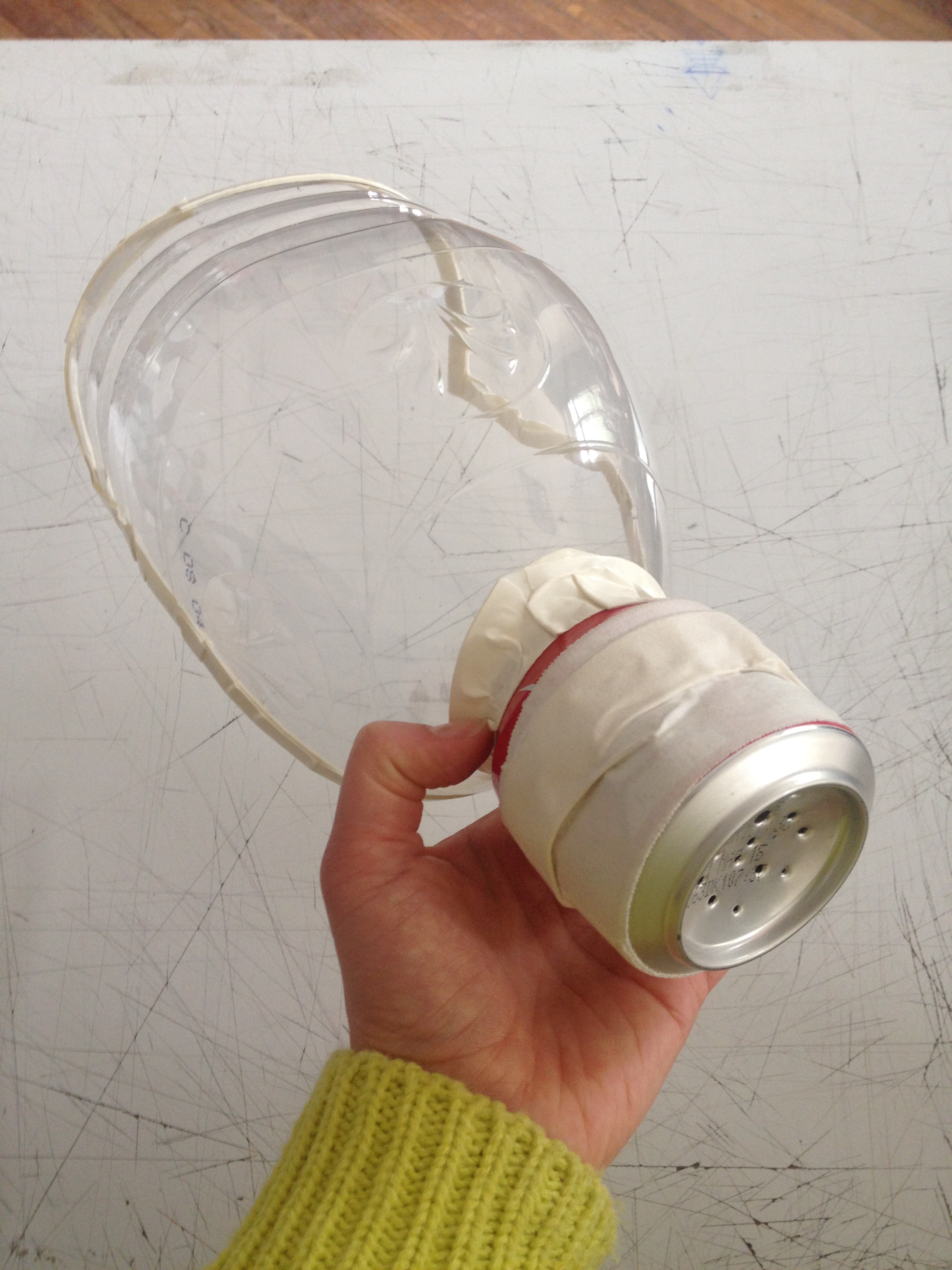
The aWEARness gas mask would help raise awareness of health problems due to burning the wires and was to be co-designed with the community in Agbogbloshie. The latest prototype uses papier maché technique so the mask could fit every single e-waste worker and could be decorated [or augmented/AMP-ed up?!] using e-waste parts.

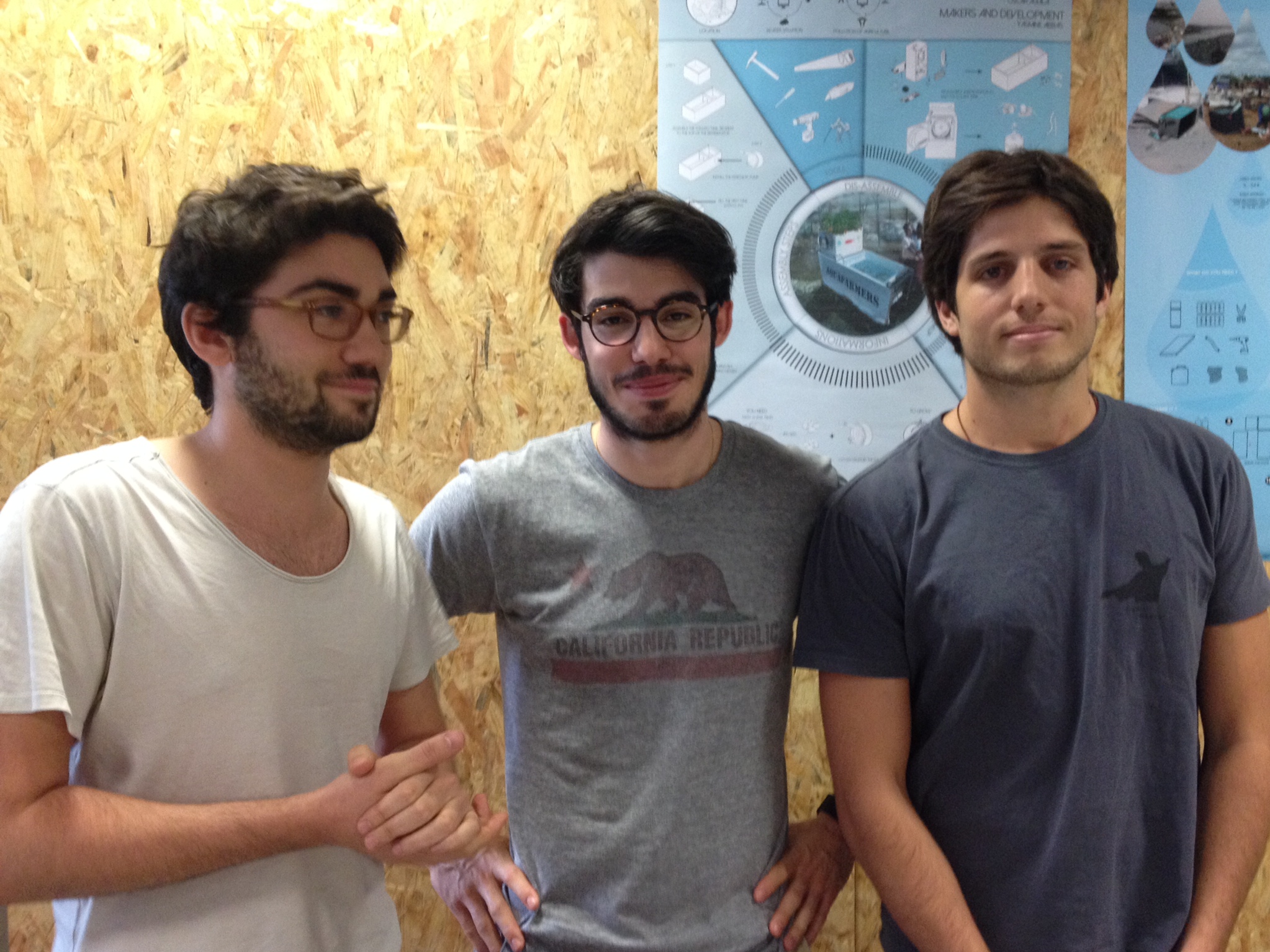
hydroponic teamPoster by Oscar AGUILA (right), Nicolas BENMUSSA (left) and Charles CLEMENT (middle)

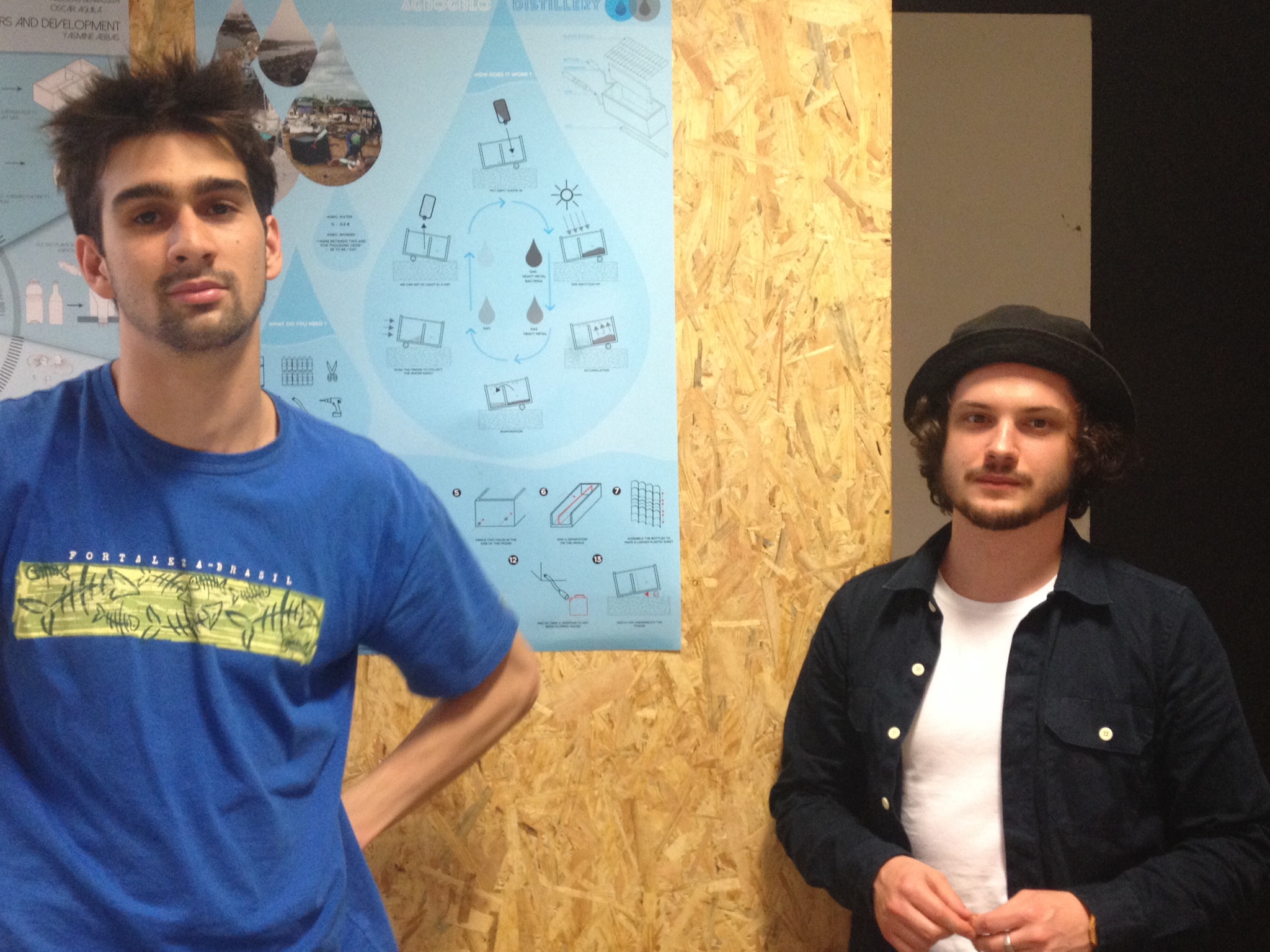
distillery teamPoster by Gautier PIECHOTTA (right) and Ferdinand SIMON (left)

awearness team

awearness 2

awearness 1aWEARness mask prototypes by Sibylle PERRIER (middle), Edouard REGNIER (left) and Maryam SAAD (right)

Video of the MAP.US concept presented by Vlad DARABAN and Diana DURAND-RUEL

Momo Paris: the multiple facets of mobile usage in Africa

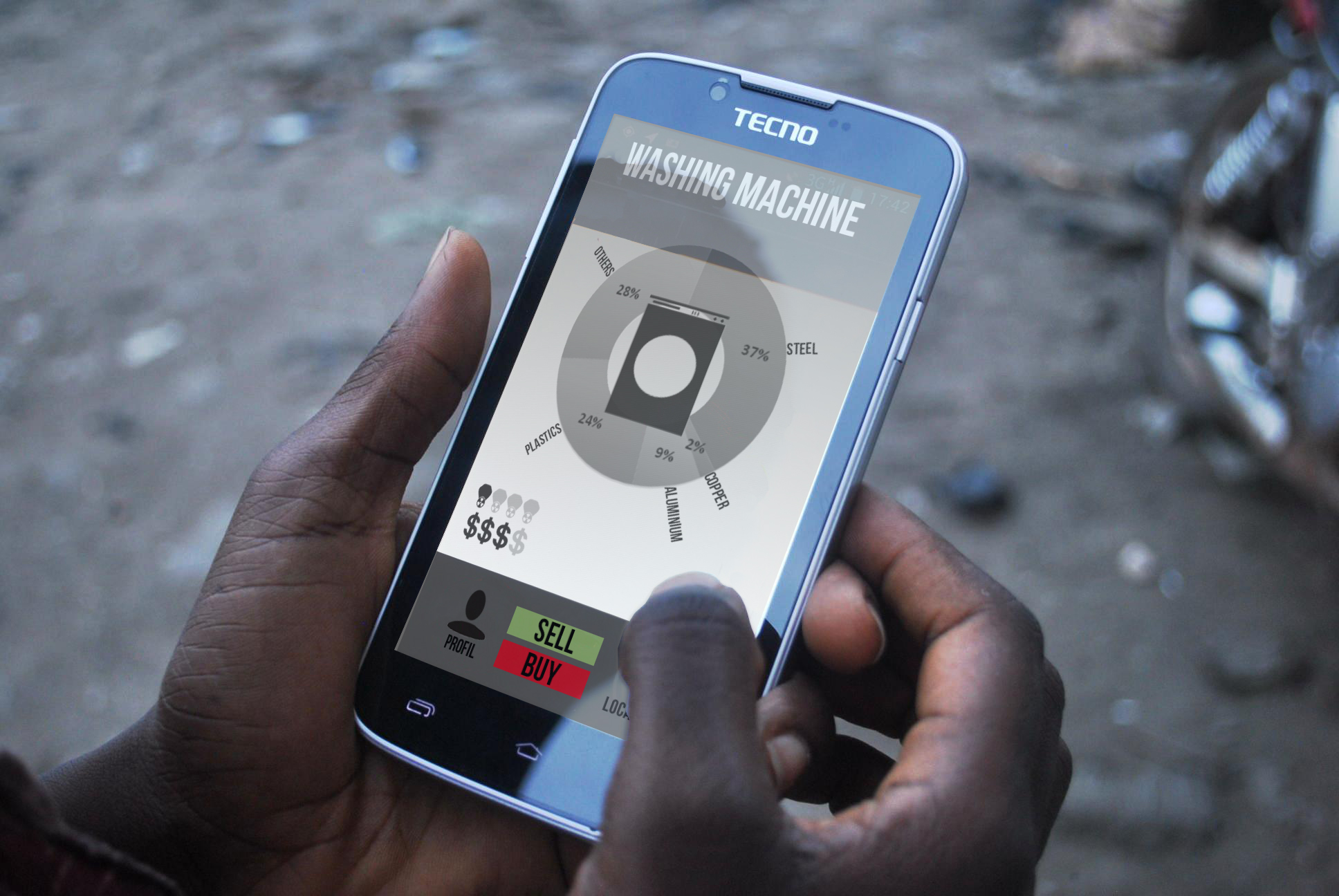
On May 19, 2014, Yasmine Abbas (AMP co-founder) gave a 10 minutes presentation on AMP and AMP’s mobile phone application for makers in Africa at the Mobile Monday (MoMo) event held at the NUMA. Currently the team uses mobile phone to map fieldwork in Agbogbloshie. The AMP digital platform, yet to be developed, is thought to become a mobile learning and banking tool. Via the AMP digital platform, makers will be able to get information on e-waste, to share how to manuals and information on makers’ production–MADE IN AGBOGBLOSHIE–, to get training on (dis)assembly–we are very much inspired by the videos of the Khan Academy (ours will be filmed in the spacecraf)t. The digital platform is envisaged to become a commercial platform to sell makers’ production and make micro-finance transactions. We are working on the project–so don’t get caught by the use of a smart phone (which are increasingly available in Africa) to visualize the concept!

AMP MoMo Image produced by intern Yasmine Sarehane

During that event, UNICEF representatives mentioned the Rio Youth Mapping project developed in collaboration with the MIT Mobile Experience Lab.

This project explores tools to help youth in Rio de Janeiro build impactful, communicative digital maps using mobile and web technologies. A phone application allows youth to produce a realtime portrait of their community through geo-located photos and videos, organized in thematic maps.

This project is evidently of great inspiration to us as we are developing maps to visualize fieldwork conducted in Agbogbloshie.

M&D Mid-Review

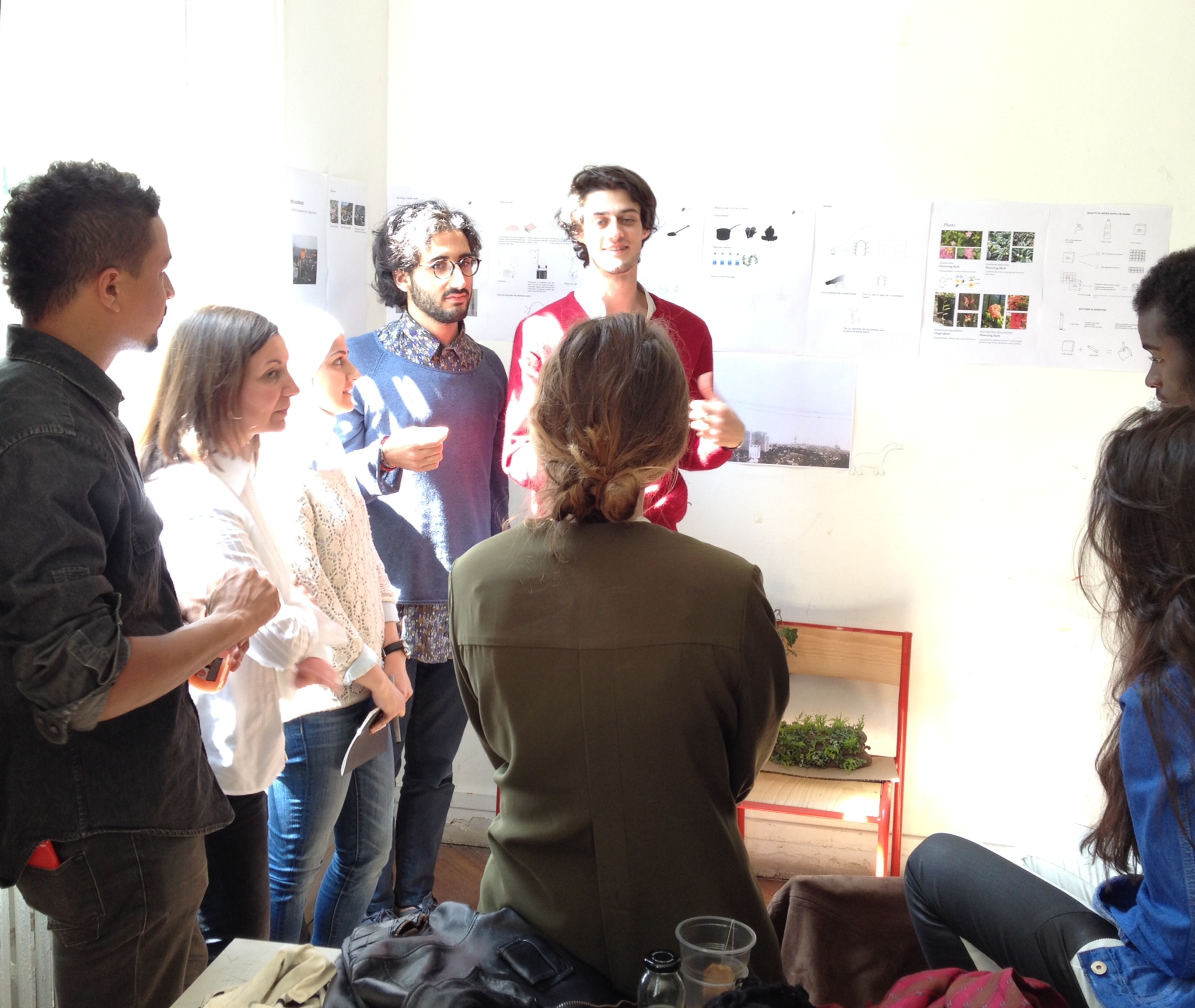
Dk Osseo-Asare, Low Design Office principal and AMP (Agbogbloshie Makerspace Platform) co-founder was in Paris for the M&D mid review (Semester 6 course taught by Yasmine Abbas) carried out in parallel with that of Make (S5 course taught by Marie Aquilino). Having conducted fieldwork in Agbogbloshie for over 6 months and with his 7 years of experience working on the informal sector, community participation and kiosk culture, Osseo-Asare provided students with invaluable insights on usability, community needs and buy-in. Amongst the numerous projects presented were a hydroponic micro-farm (using old refrigerators) to grow tomatoes (S6), a “water distillery” to extract cleaner water from polluted rain water (S6), a gas mask called “awearness” to provide protection against toxic fumes (S6) and a concept for a green wall to create safer enclaves in Agbogbloshie (S5). S6 Students had to show early prototypes and a poster (akin to those presented at scientific conference) to explain their design.

M&D mid review

hydroponic Prototype of a hydroponic micro-farm by Oscar AGUILA, Nicolas BENMUSSA and Charles CLEMENT (S6)

The Emergent Vernacular

Sénamé-Behrang

The M&D seminar organized a round table on the emergent vernacular.

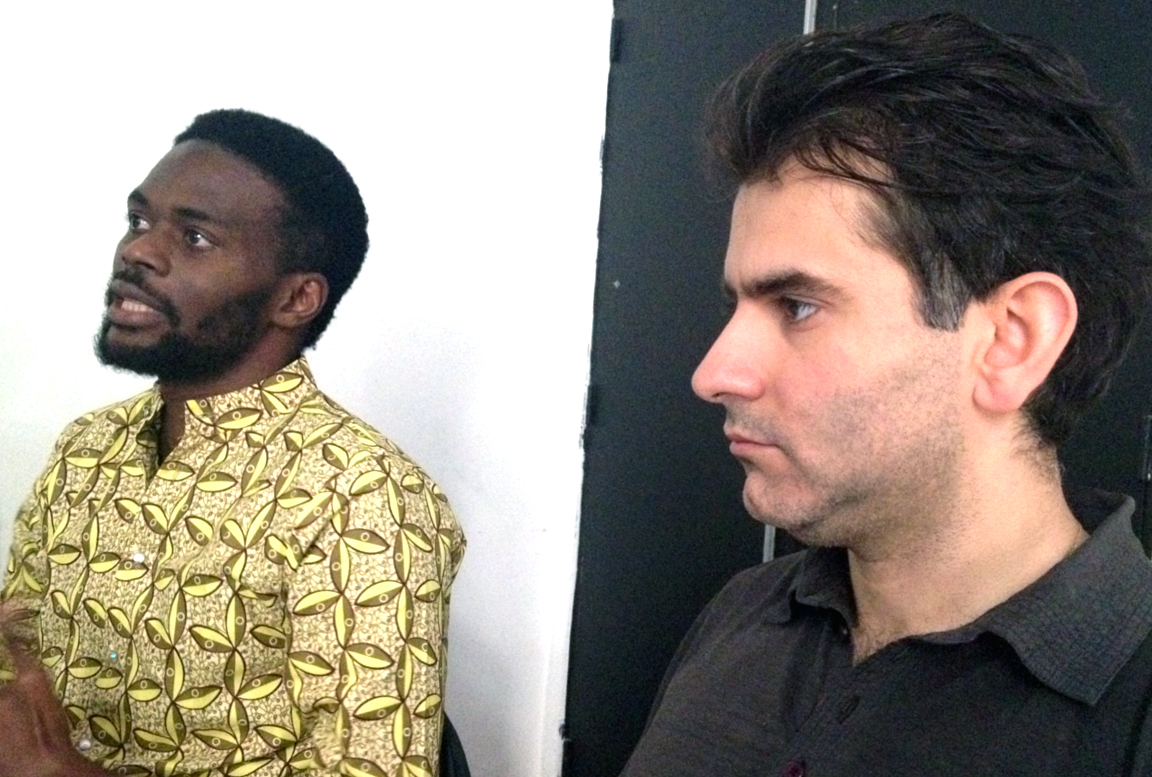
Behrang Fakharian, vernacular architecture expert and Sénamé Koffi A., architect and anthropologist, co-founder of the association L’Africaine d’Architecture and the Woelab, the first makerspace in Togo, have shared their respective experiences to explore the hypothesis that vernacular architecture and “open-source” design have comparable modes of production such as the peer-to-peer transmission of knowledge or the creation of “architecture without architectes”.

The Makers and Development seminar is a semester 6 course taught by Yasmine Abbas, Professeur Associé at l’Ecole Spéciale d’Architecture. People of the seminar MAKE, a semester 5 course taught by Marie Aquilino at l’ESA, joined the round table. The M&D and MAKE seminars are organized as a vertical offering to explore in depth issues of making in complex contexts.

We filmed the conference and we hope to share it with you very soon!

Meanwhile, find some readings/viewings on the neo-vernacular here and here.

M&D STUDENTS WINS THE PRESELECTION TO THE 2014 NASA CHALLENGE!

[FRENCH]
[ Original post by Yasmine Abbas]

12-13 April 2014, “student seminar S6 Makers & Development (M & D) taught by Yasmine Abbas and seminar S5 Make taught by Marie Aquilino had the opportunity to participate in the hackathon organized by the NUMA (first space Co-working in Paris) and CNES . The event took place at fablab the Digital Crossroads 2 of the Cité des Sciences (with stunning views of the Geode!). Students are divided into three interdisciplinary teams to meet NASA challenges that republishes a series of challenges organized into five themes: robotics, technologies related to space, space travel, observation of asteroids and the planet earth.

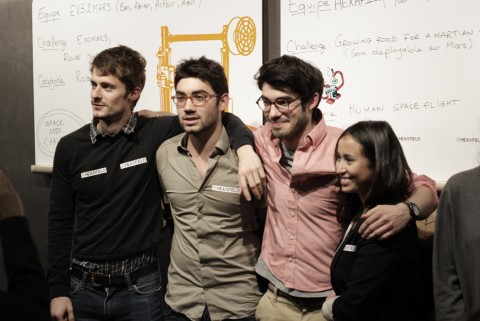
Hexafield TeamHexafield Team from left to right – Frederic Grandjean, Nicolas Benmussa (ESA S6), Charles Clement (ESA S6) and Yasmine Sarehane (S9) whose work focuses on the degree of lunar habitat © Guilhem Boyer

A team worked on the deflection of an asteroid, the other on creating a budget small satellite and the third generation of a deployable greenhouse on Mars. The educational goal was to immerse themselves in the world of a fablab pourproduire in one weekend a coherent concept in collaboration with people from different worlds and discussion with teachers from both seminars (coaches mobilized for the weekend) and robotics experts (including Olivier Grossat who spoke to ESA for a conference and workshops on 3D printers), computer and user experience.

This is the public, visitors to the city of sciences and participants hackathon, which ultimately decided the two winning teams from the five who competed. Students were part of the ESA-teams HEXAFIELD Send “flowers” on Mars (the greenhouse on Mars) and SWARM EXPLORER (satellite budget)!

Yasmine Sarehane (S9), Nicolas Benmussa (S6), Charles Clément (S6), Kawtar Sayegrih (S5) and Muriel Ferneini (S5) now “galactic problem solvers” were among the shortlisted for the support of the NASA teams and each received a membership card for one year fablab the Cité des Sciences. ”

Read more .